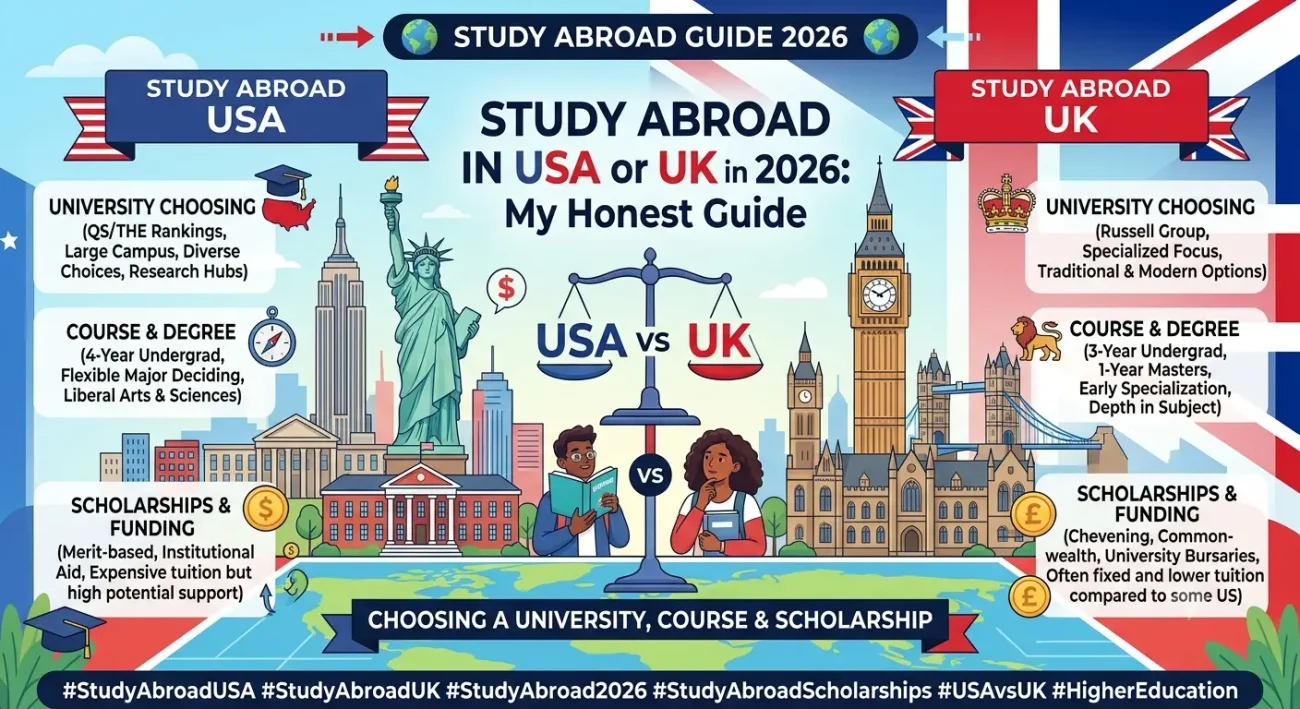
By Shivansh
If you are planning to study abroad in 2026, there is a good chance you have already opened dozens of university websites and searched something like “USA vs UK study abroad”.
I have been there too. At first, I thought the decision would be simple: compare university rankings, look at tuition fees, find a scholarship and choose a country.
It turned out to be much more complicated.
The more I researched universities, courses, scholarships, living costs and visa requirements, the more I realised that choosing between the USA and UK is not really about finding one universally “best” destination.
It is about finding a combination of course, university, budget, location and career opportunities that makes sense for you.
That is the approach I would use if I were making my study abroad decision again.
In this guide, I am sharing how I would compare study abroad in USA vs UK, what I would check before applying, how I would search for study abroad scholarships, and the mistakes I would try to avoid.
USA vs UK Study Abroad: I Would Start With the Course, Not the Country
My biggest change in thinking came when I stopped asking, “Which country is better?” and started asking, “What exactly do I want to study?”
That sounds obvious, but it makes a surprisingly big difference.
EducationUSA’s official guidance recommends beginning the U.S. university research process well in advance and focusing on a university that matches your academic, financial and personal priorities. EducationUSA currently suggests starting research around 12 to 18 months before the academic year you hope to attend. EducationUSA’s research guidance is a useful starting point.
So if I were starting my search, I would first write down:
- What subject do I genuinely want to study?
- Do I want an undergraduate, postgraduate or professional programme?
- What type of teaching style suits me?
- What is my maximum realistic budget?
- How much scholarship support would I need?
- Would I prefer a large city, smaller city or campus environment?
- How important are internships and industry connections?
- Do I want to focus more on employment, research, entrepreneurship or another goal?
- What do I want my career to look like after graduation?
Once those answers are clearer, comparing universities becomes much easier.
How I Would Choose a University in the USA
One thing that stands out to me when researching universities in the USA is the sheer variety.
You can find huge public universities, private universities, smaller colleges, research-focused institutions, urban campuses and universities located in quieter areas.
That variety is exciting, but it can also make the decision overwhelming.
I would solve that by creating a simple comparison sheet before applying.
| Factor | What I Would Check |
|---|---|
| Course | Modules, curriculum, specialisations and flexibility |
| Total Cost | Tuition, housing, food, insurance, transport and other expenses |
| Scholarships | Eligibility, award amount, deadline and conditions |
| Location | City, climate, transport and estimated living costs |
| Career Support | Internships, career services, employer connections and practical opportunities |
| Academic Environment | Research, facilities, class structure and student resources |
| Application | Entry requirements, documents and deadlines |
EducationUSA makes an important point that I think students sometimes overlook: the goal is not to force yourself into a university, but to find an institution that fits your academic, financial and personal priorities.
I would keep that idea in mind throughout the application process.
What I Would Look For in a UK University
The UK study abroad experience can be quite different from one university and course to another.
For me, the most important thing would be reading the actual course page.
A university may have an impressive name, but that does not automatically mean its particular programme is right for me.
I would look at:
- Course modules
- Optional subjects
- Assessment methods
- Teaching format
- Placement or internship opportunities
- Research opportunities
- Career support
- Accommodation options
- Location and transport
- Total cost of attendance
I would also compare the course structure carefully. Two programmes with almost identical names can have very different content.
My personal test would be simple:
“If I removed the university’s name from the page, would I still want to study this course?”
If the answer is no, I would continue researching.
USA vs UK: How I Would Compare Courses
This is probably the most important part of my decision.
When students search for study abroad USA or study abroad UK, it is tempting to create a country-versus-country comparison.
I think that can hide the real differences.
I would compare specific programmes instead.
For example, if I were interested in business or an MBA, I would investigate:
- Core subjects
- Specialisation options
- Internship or placement opportunities
- Industry projects
- Consulting opportunities
- Career services
- Alumni network
- Class size
- University location
- Total programme cost
For engineering, I would pay additional attention to laboratories, research facilities, technical modules, industry partnerships, practical projects and relevant accreditation.
For computer science, I would look closely at subjects such as artificial intelligence, data science, cybersecurity, software engineering or whatever specialisation actually interests me.
The point is simple: I would compare course to course, not just USA to UK.
Study Abroad Scholarships: How I Would Actually Search
Scholarships deserve their own research process.
I would not wait until I had already applied to universities before thinking about funding.
For the USA, EducationUSA provides guidance on financing studies and encourages international students to consider the complete cost of studying rather than looking at tuition alone.
For the UK, there are university-specific scholarships as well as larger programmes such as the GREAT Scholarships.
For the 2026-27 academic year, the official Study UK information says GREAT Scholarships provide £10,000 toward tuition fees for eligible students on a range of one-year taught postgraduate courses. India is one of the participating countries. However, eligibility, participating universities, eligible courses and deadlines vary by institution.
One important point for students reading this during 2026: some 2026-27 scholarship deadlines may already have passed. For example, individual university pages list their own deadlines, so I would always check the current university scholarship page rather than assuming that the general GREAT Scholarship page means every opportunity is still open.
My scholarship checklist would be:
- Find the official scholarship provider.
- Check my nationality eligibility.
- Check the eligible universities.
- Check whether my specific course qualifies.
- Check academic requirements.
- Check the actual application deadline.
- Find out whether admission and scholarship applications are separate.
- Check exactly what the award covers.
- Check whether the award is renewable.
- Save a copy of the scholarship terms before applying.
I would also maintain a separate spreadsheet with scholarship name, university, eligibility, deadline, amount and application status.
It takes maybe 30 minutes to set up, but it can save hours of confusion later.
One Scholarship Mistake I Would Avoid
I would never assume that a scholarship automatically means my entire study abroad budget is covered.
A scholarship can cover a specific part of tuition without covering accommodation, food, insurance, travel or other expenses.
So if I see a headline saying “£10,000 scholarship”, my next question would be:
“£10,000 toward which cost?”
That small question changes the way you calculate your budget.
For example, the current GREAT Scholarship information for India describes the £10,000 award as a contribution toward tuition fees, rather than a promise to cover every expense associated with studying in the UK.
How I Would Calculate My Real Study Abroad Budget
Tuition is only one part of the financial picture.
If I were preparing my own budget, I would include:
- Tuition fees
- Accommodation
- Food and groceries
- Health insurance or healthcare-related expenses
- Local transportation
- Books and study materials
- Visa costs
- Flight tickets
- Application-related expenses
- Emergency savings
- Personal spending
I would also calculate the budget for the entire programme, not just the first semester.
Location matters as well. The cost of living can be very different between cities, even within the same country.
This is why I would not look at a university’s tuition fee and immediately decide that one country is cheaper.
Total cost of attendance is the number I would actually compare.
UK Student Visa: What I Would Check
Visa information is one area where I would avoid relying on random social media posts or old YouTube videos.
For the UK, the official GOV.UK Student visa guidance says students generally need an offer from a licensed student sponsor, sufficient funds for the course and living costs where required, and to meet the relevant English-language requirements. The exact requirements depend on the student’s circumstances.
If applying from outside the UK, the current guidance says the earliest you can apply is six months before the course starts. You also need the required Confirmation of Acceptance for Studies (CAS) before applying.
The financial requirement is also something I would check carefully. GOV.UK currently lists different monthly maintenance amounts depending on whether the course is in London or outside London, and the evidence requirements can depend on the applicant’s circumstances.
Because immigration rules, fees and financial requirements can change, I would check the official GOV.UK guidance again immediately before submitting a visa application.
What About the USA Student Visa?
For the USA, I would treat the visa as one part of a larger preparation process rather than something to think about after everything else is finished.
EducationUSA currently presents the U.S. preparation process in five broad stages: researching study options, financing studies, completing the application, applying for a student visa and preparing for departure.
I like this structure because it encourages students to think about the entire journey rather than treating admission as the finish line.
I would also verify the exact visa requirements through official U.S. government and university sources before making travel plans.
USA vs UK for International Students: Questions I Would Ask
Is the USA better than the UK for international students?
I would not reduce the decision to a simple yes or no. Universities, courses, costs, locations and career opportunities vary considerably within both countries.
For me, the useful comparison is between the actual programmes I am considering.
Is studying in the USA expensive?
It can be, but there is no single price that represents every U.S. university. Tuition, housing, location and other expenses can vary significantly. Scholarships and financial aid can also change the final calculation.
Are there scholarships for international students in the UK?
Yes. International students can find university scholarships and larger programmes such as GREAT Scholarships, depending on nationality, university and course.
For 2026-27, Study UK lists GREAT Scholarship opportunities for students from India, with the award described as £10,000 toward tuition fees for eligible one-year taught postgraduate courses. Individual university deadlines and eligible courses vary.
Should I choose a university based only on ranking?
I would not.
Rankings can be useful for discovering universities, but they do not tell me whether a specific course fits my goals, budget, preferred location or learning style.
I would use rankings as one research input and then investigate the actual programme.
How early should I start planning?
I would start as early as possible. EducationUSA currently recommends beginning U.S. university research around 12 to 18 months before the academic year you plan to attend.
That does not mean every student needs exactly 18 months, but it shows why waiting until the last few weeks can create unnecessary pressure.
My 10-Step Study Abroad 2026 Checklist
If I were sitting down today and starting my application planning, I would follow this order:
- Choose the subject. Start with what you want to study rather than a famous university.
- Set a realistic budget. Include living costs and unexpected expenses.
- Create a university shortlist. Compare several options rather than focusing on one institution.
- Read the actual course pages. Check modules, assessment and programme structure.
- Research scholarships separately. Admission and funding are not always the same process.
- Track deadlines. Put application and scholarship deadlines into a calendar.
- Prepare documents early. Transcripts, references and personal statements can take time.
- Research visa requirements. Use official government sources.
- Research the city. Think about accommodation, transport, lifestyle and living costs.
- Make the final comparison. Look at the complete picture rather than one attractive number.
What I Would Personally Compare Before Saying Yes to a University
When I finally reach the point where I have multiple offers or shortlisted universities, I would create one final comparison.
| Question | Why It Matters to Me |
|---|---|
| Do I actually like the course? | I will be studying it for a significant amount of time. |
| Can I realistically afford it? | A good university is not useful if the finances are unsustainable. |
| What happens after graduation? | I want to understand the career support and opportunities available. |
| Do I like the location? | Student life exists outside the classroom too. |
| What funding is confirmed? | I want to distinguish confirmed funding from possible funding. |
| What are the visa requirements? | Admission alone does not complete the process. |
| Does the university fit my goals? | Personal fit matters alongside academic reputation. |
This final step is where I think a lot of students can benefit from slowing down.
When you have spent months dreaming about studying abroad, it is easy to become emotionally attached to one university.
I would try to step back and look at the numbers and details again.
USA or UK: How I Would Make the Final Decision
If you came here expecting me to declare one country the automatic winner, I don’t think that would be a useful way to approach the decision.
If I found a U.S. university with the course I wanted, a manageable financial plan, a location I liked and strong opportunities related to my goals, I would seriously consider it.
If a UK university offered a programme that matched my academic plans better and made more sense financially, I would consider that option instead.
That is why I would compare actual offers and programmes rather than making the decision from a generic “USA vs UK” list.
I would also be careful with social media advice.
A university can be popular online and still not be the right fit for my particular course or budget.
Likewise, a university that gets less attention online might have exactly the programme, location or funding opportunity I need.
What I Learned From Researching Study Abroad Options
The biggest lesson for me is that study abroad research becomes much easier once you stop trying to find a universal answer.
There is no single checklist that will be perfect for every student.
A student interested in research may care deeply about laboratories and faculty. Someone focused on business may care more about internships, location and industry connections. Another student may need substantial financial assistance before even considering a university.
All of those priorities are valid.
That is why I would build my shortlist around my own requirements instead of copying somebody else’s university list.
My Final Thoughts on Study Abroad in USA vs UK
If I had to summarise my entire approach in one sentence, it would be this:
Don’t choose a country first and then try to justify the university; choose the academic and financial fit first, and let that guide the country decision.
When researching study abroad 2026, I would spend less time asking which country sounds more impressive and more time checking the details that will actually affect my life.
Read the modules.
Calculate the complete cost.
Check the scholarship conditions.
Look at the city.
Research the visa.
Understand the application timeline.
And most importantly, think about what you want to do after graduation.
That process may not feel as exciting as scrolling through university rankings, but I think it produces a much more realistic decision.
For me, the best question is not:
“Which university is the best?”
It is:
“Which university gives me the right course, a realistic financial plan, useful opportunities and an environment where I can genuinely see myself succeeding?”
That is the question I would keep coming back to throughout my own study abroad research.
Official Resources I Would Bookmark
- EducationUSA – Your 5 Steps to U.S. Study
- EducationUSA – Research Your U.S. Study Options
- EducationUSA – Financing U.S. Studies
- Study UK – Choosing a University
- Study UK – Choosing a Course
- Study UK – Scholarships and Funding
- Study UK – GREAT Scholarships for India
- GOV.UK – Student Visa
- GOV.UK – Student Visa Financial Requirements
Frequently Asked Questions
What are the main differences between studying in the USA and UK?
The differences can include course structure, programme length, university systems, tuition, living costs, application processes, location and the type of academic experience available. The actual difference depends on the university and programme you choose.
Can international students get study abroad scholarships?
Yes. International students can find university scholarships, government-backed programmes and other funding opportunities. Eligibility varies by nationality, university, course and scholarship.
Are there UK scholarships for Indian students in 2026-27?
Yes. The official Study UK GREAT Scholarship programme lists opportunities for students from India for the 2026-27 academic year. The programme describes awards of £10,000 toward tuition fees for eligible one-year taught postgraduate courses, but participating universities, eligible courses and deadlines vary.
Can I still apply for every 2026-27 scholarship?
No. Scholarship deadlines are not necessarily the same for every university. Some 2026 deadlines have already passed, while the status of individual opportunities depends on the institution. Always check the current university scholarship page before applying.
Should I choose a university based on ranking?
I would use rankings as one research tool rather than the only deciding factor. Course content, total cost, location, career opportunities, facilities and personal priorities can be more directly relevant to your individual decision.
How early should I start researching U.S. universities?
EducationUSA currently recommends beginning research around 12 to 18 months before the academic year you hope to attend. Starting early also gives students more time to research scholarships, prepare documents and understand application deadlines.
When can I apply for a UK Student visa?
For applicants applying from outside the UK, GOV.UK currently says the earliest application point is six months before the course starts. Students should check the latest official requirements before applying because visa rules and financial requirements can change.
What should I check before applying to a university abroad?
I would check the exact course, entry requirements, tuition, estimated living expenses, scholarship opportunities, application deadlines, location, career support and visa requirements. I would also read the official university course page rather than relying only on third-party university lists.
Is a scholarship enough to cover the complete cost of studying abroad?
Not necessarily. A scholarship may cover tuition or a specific portion of the total cost without covering accommodation, food, travel, insurance and other expenses. Always read the scholarship terms and calculate the remaining amount yourself.
Where can I find official information about studying in the USA?
EducationUSA, a U.S. Department of State network, provides information and guidance for international students researching U.S. higher education.
Where can I find official information about studying in the UK?
Study UK provides information about UK universities, courses and scholarships, while GOV.UK provides the official Student visa and immigration guidance.
