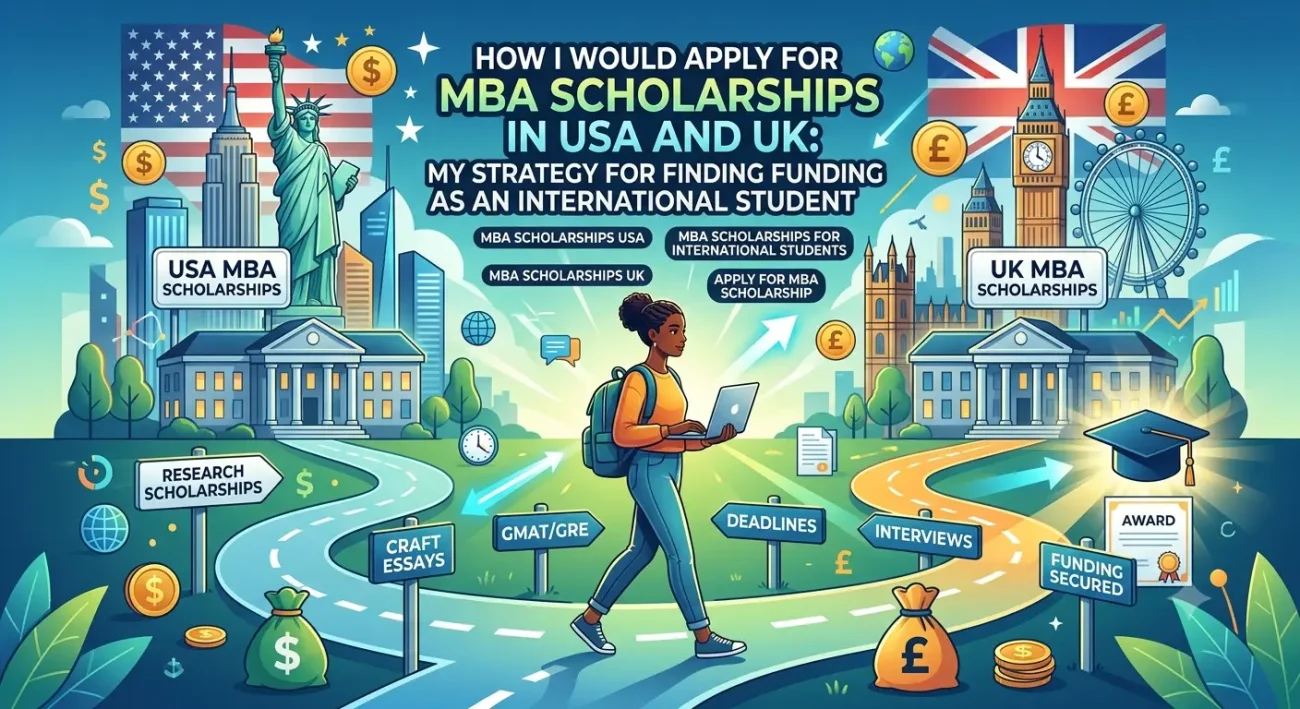
By Shivansh | Shivansh Abroad
When I first started seriously researching an MBA abroad, I thought the difficult part would be choosing the right business school.
Then I started looking at the actual cost.
Tuition was only one part of the calculation. There were also living expenses, health insurance, travel, visa-related costs and other day-to-day expenses. That completely changed the way I looked at studying for an MBA overseas.
I stopped asking only, “Which MBA is good?” and started asking a more practical question: “How would I realistically finance this MBA?”
That is what led me to research MBA scholarships in the USA, MBA scholarships in the UK, university funding, merit-based scholarships and financial support for international students.
My biggest lesson was that scholarship research should not be something I do after receiving an admission offer. I would build it into my MBA application strategy from the beginning.
In this guide, I am sharing how I would approach MBA scholarships for international students, what I would check before applying, how I would organize scholarship research and the mistakes I would personally try to avoid.
Quick answer: If I were applying for an MBA in the USA or UK today, I would first create a shortlist of realistic MBA programs, then check each university’s official funding options, confirm whether the specific MBA is eligible, record every deadline and prepare scholarship essays around my actual experience rather than using generic motivational statements.
Why I Would Search for MBA Scholarships Before Applying
One mistake I would try very hard to avoid is waiting until I receive an MBA admission offer before researching scholarships.
I would start much earlier.
The reason is that admission requirements and scholarship requirements are not always identical. A university may welcome international MBA applicants while a particular scholarship may have additional restrictions based on nationality, course, study mode, academic background, professional experience or application timing.
The UK’s official Study UK scholarship information is a good example. GREAT Scholarships can provide £10,000 toward tuition for eligible one-year taught postgraduate courses, but the participating universities and eligible courses vary by country and institution.
So my first rule would be simple:
Never assume that a scholarship available at a university is automatically available for its MBA.
I would always open the official scholarship page and check the exact course eligibility.
My First Step: Calculate the Real MBA Cost
Before chasing scholarships, I would calculate what I would actually need to pay.
For me, the basic calculation would be:
Total tuition + estimated living expenses + insurance + travel and visa-related costs − confirmed funding = estimated amount I still need to finance.
This matters because a scholarship headline can sometimes look more impressive than its actual impact on the total cost.
For example, a £10,000 tuition scholarship sounds substantial, and it can be very useful. But if the remaining tuition and living expenses are still significant, I would need to understand the complete financial picture before deciding whether the university fits my budget.
I would therefore compare net cost, not just scholarship amount.
How I Would Search for MBA Scholarships in the USA
If I were researching MBA scholarships in the USA, I would start with the business schools themselves.
I would still use reputable external databases and scholarship resources to discover opportunities, but I would treat the university’s official scholarship page as the final source for eligibility and application instructions.
My scholarship spreadsheet would contain:
- University name
- MBA program
- Scholarship name
- Scholarship value
- International student eligibility
- MBA eligibility
- Full-time, part-time or online eligibility
- Separate application requirement
- Admission deadline
- Scholarship deadline
- Essay or video requirements
- GMAT, GRE or other requirements, if applicable
- Professional experience requirements
- Whether the scholarship can be combined with other awards
- Official scholarship URL
I would also keep a column called “Last checked”.
That small column can be surprisingly useful because scholarship information changes. An opportunity available for one academic year may have different eligibility or deadlines the following year.
The Three Types of US Funding I Would Look For
1. Merit-Based MBA Scholarships
These would be one of the first categories I would investigate.
I would not assume that merit simply means having the highest GPA.
For MBA applicants, universities can consider a combination of academic performance, professional achievements, leadership, entrepreneurial experience, community involvement and the overall strength of the application.
So if I had managed a project, built a business, improved a process at work or led a meaningful initiative, I would make sure those experiences were clearly represented in my application.
2. Need-Based Financial Support
I would also check whether the specific business school provides financial support based on demonstrated financial need.
This is an area where I would be particularly careful with assumptions.
International students do not necessarily receive the same financial aid options as domestic students, and the rules can differ significantly between universities.
I would therefore check the university’s official financial-aid and MBA funding pages rather than relying on a general statement such as “this university offers financial aid.”
3. External Scholarships
Finally, I would search outside the university.
I would look at government programs, foundations, professional organizations, nonprofit scholarship providers and reputable scholarship databases.
But I would use external websites mainly for discovery. Before applying, I would verify the opportunity directly with the scholarship provider.
How I Would Approach MBA Scholarships in the UK
The UK would be especially interesting to me because there are both university-specific funding opportunities and broader scholarship programs.
One of the major programs I would investigate is the GREAT Scholarships program.
For the 2026–27 academic year, Study UK says GREAT Scholarships provide £10,000 toward tuition for eligible one-year taught postgraduate courses. More than 140 scholarships are being offered through more than 60 universities, with eligibility varying by country and university.
For an Indian student, the official Study UK India page says that the 2026–27 GREAT Scholarships are available at participating institutions and that applicants should check the individual university pages for eligible courses and application instructions.
This is exactly why I would not search for a scholarship only by its name.
I would search for:
- Scholarship name
- My nationality
- My exact MBA course
- Study mode
- Academic year
- University
- Application deadline
A Real 2026 Example: GREAT Scholarship and MBA Eligibility
One of the most useful lessons from my research is that even a major scholarship program can have very different course rules at different universities.
For 2026–27, Anglia Ruskin University lists a £10,000 GREAT Scholarship for eligible students from India, and its India-specific eligible courses include the MBA FinTech and Data Analytics.
However, the University of Manchester provides an important counterexample. Its 2026–27 GREAT Scholarship information specifically excludes the MBA from the eligible programmes.
That difference is exactly why I would never write “University X offers GREAT Scholarships” and stop there.
I would ask:
- Is the scholarship available to my nationality?
- Is my exact MBA eligible?
- Is my study mode eligible?
- Do I need an admission offer first?
- Is there a separate scholarship application?
- What is the actual deadline?
Those details are much more useful to an applicant than simply knowing the headline scholarship amount.
My MBA Scholarship Research Table
If I were applying today, I would maintain a table like this:
| University | Country | Funding Route | Amount | MBA Eligible? | Application Method |
|---|---|---|---|---|---|
| Anglia Ruskin University | UK | GREAT Scholarship 2026–27 | £10,000 | MBA FinTech and Data Analytics for eligible Indian applicants | Check official university instructions |
| University of Manchester | UK | GREAT Scholarship 2026–27 | £15,000 | No — MBA excluded | Not applicable for MBA |
| Imperial College Business School | UK | Selected MBA scholarships | Varies by award | Course-specific | Varies by scholarship |
This table also demonstrates why I would record the eligibility result, not just the scholarship name.
For example, Imperial College Business School currently lists several MBA funding options. Its Full-Time MBA funding information includes awards such as the Advisory Board Scholarship and Dean’s Impact Scholarship, with different eligibility and application requirements.
Why I Would Study Each Scholarship Separately
One thing that surprised me during scholarship research was how different two scholarships at the same university can be.
For example, Imperial’s scholarship information shows that some awards are automatically considered for eligible applicants after an offer, while other awards require an additional scholarship assessment.
The Imperial Horizons Scholarship for 2027–28, for example, says eligible MBA offer holders are automatically considered and lists support of up to 30% of tuition fees for several MBA formats.
By comparison, the Dean’s Impact Scholarship has its own eligibility criteria and requires an additional video assessment after an eligible applicant receives an offer.
That tells me something important:
I should research the scholarship process, not just the scholarship amount.
What I Would Write in My Scholarship Essay
This is probably the part of the application where I would spend the most time.
I would avoid writing an essay that sounds like this:
“I have always dreamed of studying at a prestigious university and becoming a successful global business leader.”
There is nothing necessarily wrong with that sentence, but it could belong to thousands of applications.
I would rather explain something that actually happened to me.
My basic structure would be:
- What did I do?
- What problem or challenge did I face?
- What action did I personally take?
- What happened as a result?
- What did I learn?
- Why does an MBA make sense for my next step?
If I had managed a team, I would explain what I actually managed.
If I had started something, I would explain why I started it and what happened afterward.
If I had made a mistake, I would explain what I learned instead of pretending that everything in my career had been perfect.
That would make the essay sound much more like me and much less like a template.
I Would Use Numbers When They Actually Add Meaning
Another thing I would change in my own application is the way I describe achievements.
Instead of saying:
“I significantly improved the performance of my team.”
I would use a measurable result if one genuinely exists.
For example:
“I helped reduce the average processing time from 48 hours to 31 hours over six months.”
The important part is that the number should be real.
I would never invent percentages, revenue figures or leadership achievements simply because they look impressive in a scholarship essay.
How I Would Explain a Weak Part of My Profile
Most applicants have something they would rather not highlight.
It could be a weak semester, a career break, a change of industry, a low test score or a period where professional progress was slower than expected.
If I had something like that, I would not spend an entire essay making excuses.
I would explain the situation briefly and focus on what happened afterward.
My approach would be:
- Explain the situation honestly.
- Take responsibility where appropriate.
- Explain what changed.
- Show evidence of improvement.
- Connect that experience to my future goals.
For me, the goal would not be to create a perfect-looking profile. It would be to give the admissions or scholarship committee an accurate picture of how I developed.
Should I Apply Early?
I would pay close attention to application rounds.
That does not mean every scholarship automatically favors the earliest applicant. It means I would check whether the university has limited scholarship availability, round-specific scholarship deadlines or recommendations to apply earlier.
For example, Imperial’s previous Dean’s Impact Scholarship information noted that only a limited number of awards were available and encouraged applicants to apply in an earlier admission round.
Current scholarship pages can change from year to year, so I would always check the relevant year’s official page before relying on an old deadline or application rule.
Do I Need a Separate Scholarship Application?
Sometimes yes, and sometimes no.
This is one of the first questions I would answer for every scholarship.
There are several possible situations:
- The university automatically considers eligible applicants.
- You must receive an admission offer before applying.
- You must submit a separate scholarship form.
- You must complete an essay or video assessment.
- You must apply by a separate scholarship deadline.
Imperial provides a good example of why this distinction matters. Its current MBA funding information includes scholarships where eligible applicants are automatically considered and others where applicants complete an additional assessment after receiving an offer.
So I would never copy the scholarship procedure from another university.
My Biggest Mistake Would Be Chasing Only the Largest Scholarship
If I saw a very large scholarship, I would obviously investigate it.
But I would not make the scholarship amount the only deciding factor.
Suppose one university offers a larger scholarship but has substantially higher remaining tuition and living expenses. Another university might offer a smaller award but leave me with a lower overall cost.
That is why I would compare:
- Total tuition
- Scholarship value
- Remaining tuition
- Estimated living expenses
- Insurance
- Travel costs
- Visa-related expenses
- Expected duration of the program
My actual target would be understanding the remaining cost after confirmed funding.
What I Would Do If a Scholarship Is Not Available
I would not immediately remove a university from my list just because one scholarship was unavailable.
I would look for other forms of funding.
Depending on the university and my circumstances, I might investigate:
- Other university scholarships
- Tuition discounts or bursaries
- External scholarships
- Employer sponsorship
- Education loans
- Government-supported funding where eligible
- Assistantship opportunities where applicable
I would also check whether funding can be combined.
Some scholarships may allow multiple awards while others may have restrictions. I would never assume that two awards can automatically be stacked together.
Questions I Would Ask Before Applying
Can international students apply for MBA scholarships?
Yes, some MBA scholarships are open to international students, but eligibility depends on the university, scholarship and program. I would check the specific award rather than assuming that all international students qualify.
Are MBA scholarships in the USA fully funded?
Not necessarily. Funding can range from partial tuition support to much larger awards. I would check whether the scholarship covers tuition only or also contributes toward other expenses.
Are there MBA scholarships in the UK for international students?
Yes. UK universities and scholarship programs offer funding opportunities for international students, but the exact MBA eligibility varies. GREAT Scholarships are one example, and Study UK publishes country- and university-specific information.
Is the GREAT Scholarship automatically available for every MBA?
No. The eligible courses vary by university and country. For example, Anglia Ruskin University lists MBA FinTech and Data Analytics among the eligible courses for Indian applicants for 2026–27, while the University of Manchester specifically excludes its MBA from its 2026–27 GREAT Scholarship.
Should I apply for admission before applying for a scholarship?
It depends on the scholarship. Some awards require an offer, some automatically consider eligible applicants, and others have separate application processes. I would follow the instructions on the current official scholarship page.
Can I apply for several MBA scholarships?
Potentially, yes, but the rules differ. I would check whether the university permits multiple awards and whether accepting one scholarship affects eligibility for another.
Is GMAT or GRE always required for an MBA scholarship?
There is no single rule for every MBA scholarship. Requirements depend on the business school, MBA program and individual award. I would check the admission requirements and scholarship requirements separately.
How much should I budget even if I receive a scholarship?
I would budget for the expenses that the scholarship does not cover. A tuition scholarship does not automatically mean that accommodation, food, insurance, travel and other living expenses are covered.
My Final MBA Scholarship Checklist
If I were starting my applications tomorrow, this is the checklist I would keep beside me:
- Choose realistic MBA programs based on my career goals.
- Calculate the estimated total cost for each program.
- Find university-specific MBA scholarships.
- Search relevant external funding.
- Confirm international-student eligibility.
- Confirm that my exact MBA is eligible.
- Check the study mode and intake.
- Record admission and scholarship deadlines.
- Check whether an offer is required.
- Check whether a separate scholarship application is required.
- Prepare my CV.
- Collect recommendation letters early.
- Write scholarship essays using real experiences.
- Use genuine numbers and achievements.
- Check test-score requirements.
- Submit before the relevant deadline.
- Save application confirmations and supporting documents.
- Recheck the official scholarship page before submitting if the application was prepared well in advance.
My Honest Take as an International Student
If there is one thing I would tell another student researching MBA scholarships in the USA or UK, it would be this: do not start with the biggest scholarship amount.
Start with yourself.
What kind of MBA do you actually need? What career are you trying to build? Which universities fit that plan? What can you realistically afford? And which funding opportunities are genuinely available to you?
Once I answer those questions, scholarship research becomes much more manageable.
I would also stop thinking of scholarship applications as a completely separate task from the MBA application. My academic record, professional achievements, leadership examples, career goals and personal story are all connected.
If I can explain those things clearly in my MBA application, I already have much of the material I need to build a strong scholarship application.
Most importantly, I would verify every important funding detail directly from the university or scholarship provider. Scholarship amounts, eligible courses, deadlines and application procedures can change between academic years.
For me, the best scholarship strategy is not about finding a magical list of “easy MBA scholarships.” It is about doing careful research, understanding eligibility, preparing early and choosing funding opportunities that genuinely match my profile and the MBA I want to study.
Useful Official Scholarship Resources
- Study UK – Scholarships and Funding
- Study UK – GREAT Scholarships
- Study UK – GREAT Scholarships for India
- Study UK – Anglia Ruskin University GREAT Scholarship
- EducationUSA – Financial Aid
- Imperial College Business School – Full-Time MBA Fees and Funding
Frequently Asked Questions
What are the best MBA scholarships for international students?
There is no single scholarship that fits every international student. I would compare university-specific MBA scholarships, government or national programs and external funding based on eligibility, award value, course coverage and the total cost remaining after funding.
How can I apply for an MBA scholarship in the USA?
I would first identify suitable MBA programs and then check each business school’s official scholarship information. I would confirm whether international students and the specific MBA are eligible and whether a separate scholarship application is required.
How can I apply for an MBA scholarship in the UK?
I would research individual university scholarships alongside national programs such as GREAT Scholarships and then verify the exact nationality, course, eligibility and deadline requirements on the official scholarship website.
Can an MBA scholarship cover the full cost of studying abroad?
It depends on the award. Some scholarships provide partial tuition support while others can provide much larger amounts. I would check the official terms to understand exactly which expenses are covered.
What makes an MBA scholarship application stronger?
I would focus on a clear career story, specific achievements, genuine leadership or impact examples, strong recommendations and a convincing explanation of why the MBA is important for my next step. I would avoid generic claims that could apply to any applicant.
Does every UK university offer the same MBA scholarship opportunities?
No. Scholarship availability and eligibility can differ substantially between universities. Even within the same scholarship program, one university may include an MBA while another may exclude it, so I would always check the individual university’s current scholarship requirements.
