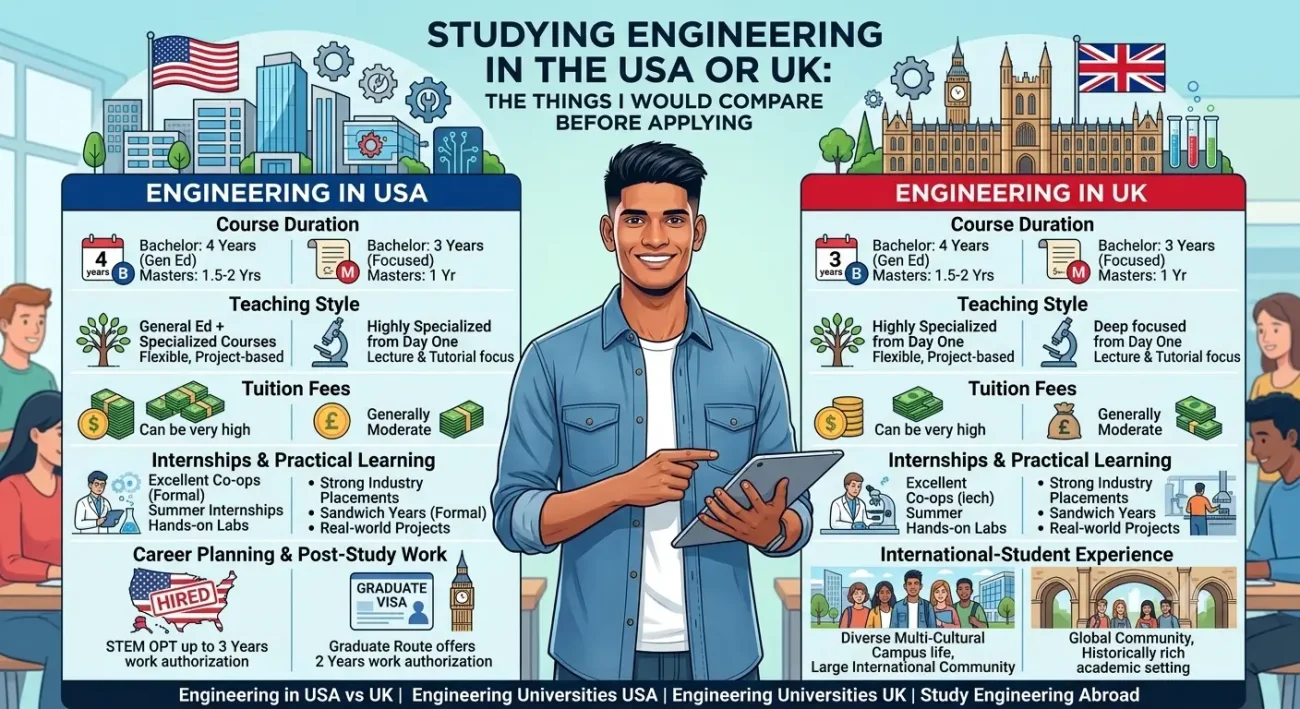
If I were choosing where to study engineering abroad today, I would not start by asking, “Which country has the better universities?” I would start with a more practical question: Which education system fits the way I want to study, spend, work and build my career?
That difference matters more than many international students realise.
When students search for engineering universities in USA or engineering universities in UK, it is very easy to get lost in university rankings, beautiful campus photographs and long lists of courses. I understand why. I have looked at universities from exactly that perspective. But after comparing the two systems, I think there are several things that deserve attention before submitting an application.
For me, the biggest questions are course duration, teaching style, tuition and living costs, practical learning, internships, career planning and the overall international student experience.
So, instead of calling one country “better”, this is how I would compare engineering in USA vs UK before making my decision.
USA vs UK for Engineering: The Basic Difference I Would Notice First
The first major difference is the structure of the undergraduate degree.
In the United States, a bachelor’s degree normally takes around four years. The American system also gives students considerable flexibility in choosing courses and exploring different academic interests. EducationUSA describes the U.S. bachelor’s degree as a four-year qualification with a wide variety of courses.
In the UK, a standard bachelor’s degree is usually three years in England, Wales and Northern Ireland, while Scotland normally uses a four-year bachelor’s structure. Some UK engineering degrees can also become four years because of an industry placement, study abroad year or foundation year.
This immediately changes how I would think about the total cost and time commitment.
| Factor | USA | UK |
|---|---|---|
| Typical bachelor’s duration | About 4 years | Usually 3 years in England, Wales and Northern Ireland |
| Academic flexibility | Generally high, with a broad range of courses | Usually more focused on the chosen subject |
| Foundation options | Varies by institution | International Foundation Years are available for some students |
| Placement options | Depends heavily on university and programme | Some degrees include an optional or mandatory industry year |
| Living-cost variation | Can vary substantially by city and state | London and other UK locations can have significantly different living costs |
I would not use this table to declare a winner. I would use it to understand which system fits my situation.
1. Course Duration: Three Years or Four Years?
This is probably the first practical calculation I would make.
If I study a typical engineering bachelor’s degree in the UK, I may complete it in three years. That can mean one less year of tuition and living expenses compared with a traditional four-year U.S. bachelor’s degree.
However, I would never assume that every UK engineering course takes exactly three years.
For example, UK universities offer engineering programmes with foundation years and industry placements. UCAS lists engineering courses that can take four or even five years when a foundation year and placement are included.
So my advice would be simple: look at the complete course structure, not just the degree title.
I would check:
- Number of academic years
- Foundation year requirements
- Placement year availability
- Study-abroad opportunities
- Whether the placement adds an additional year
- Whether the qualification is BEng, MEng or another degree structure
A three-year course is not automatically cheaper or better for every student, just as a four-year American degree is not automatically more expensive in the final calculation. The actual university, scholarship, city and personal spending habits matter.
2. Teaching Style: What Kind of Student Am I?
This is something I would think about much more carefully than university rankings.
One thing I find interesting about the U.S. system is its academic flexibility. Students can generally take a wider range of courses, although the exact amount of flexibility varies by university and engineering programme. EducationUSA highlights the broad course choice available within the U.S. undergraduate system.
For someone who is not completely certain about their specialisation, this can be useful.
The UK system is generally more subject-focused. UCAS notes that UK bachelor’s degrees typically concentrate on the chosen subject rather than requiring the same kind of general education structure found in many other systems.
Personally, this is how I would think about it:
- If I want broader academic exploration: I would investigate U.S. universities carefully.
- If I already know my engineering field: I would seriously consider focused UK programmes.
- If I want maximum flexibility: I would compare actual module requirements rather than relying on country-level assumptions.
The important word here is compare. Two universities in the same country can have completely different teaching approaches.
3. Tuition and Living Costs: I Would Calculate the Whole Budget
This is where I would be very careful.
Searching “engineering tuition USA” or “engineering tuition UK” can produce a number that looks useful but doesn’t tell the complete story.
For international undergraduate students in the UK, the British Council’s Study UK guidance currently gives a broad international undergraduate tuition range of approximately £11,400 to £38,000 per year, with actual fees depending on the institution and course. It also notes substantial differences in living costs between London and the rest of the UK.
The U.S. system is even more important to evaluate university by university. EducationUSA notes that U.S. tuition and fees vary widely between institutions and that living costs can differ significantly depending on location.
So I would create a simple spreadsheet before applying.
| Expense | What I Would Calculate |
|---|---|
| Tuition | Annual international tuition × expected study years |
| Housing | University accommodation or private rental |
| Food | Monthly realistic student budget |
| Insurance and healthcare | Country and university requirements |
| Transportation | Local travel plus occasional long-distance travel |
| Books and equipment | Engineering-specific materials and software where applicable |
| Flights | Trips between home and university |
| Emergency fund | Money kept aside for unexpected expenses |
I would also calculate the budget using the full degree duration. A university with a higher annual cost might not necessarily have a higher total cost if the degree structure is shorter.
4. Practical Learning: Look Beyond the Word “Engineering”
When I look at an engineering course, I don’t just want to see mathematics, physics and theory listed on the website. I want to know what I will actually do.
I would look for:
- Laboratory sessions
- Design projects
- Engineering workshops
- Team-based projects
- Industry-linked assignments
- Research opportunities
- Final-year engineering projects
- Access to specialist equipment and facilities
For example, some current UK engineering courses explicitly include practical design work and industry-related facilities. The University of Birmingham’s engineering programme describes both theoretical and practical learning, including design facilities and interdisciplinary work.
That is the kind of information I would look for rather than simply writing “this university has good engineering.”
For the USA, I would use the same approach. I would visit the department page and check the actual curriculum, laboratories, project opportunities and research areas.
5. Internships: I Would Research Them Before Applying
For me, an engineering degree is not only about getting a qualification. I also want to understand how the university can help me move from classroom learning toward professional experience.
That means researching internships before applying.
I would check whether the university has:
- Career fairs specifically for engineering students
- Employer partnerships
- Co-op or placement programmes
- Internship support
- Engineering societies
- Alumni networks in relevant industries
- Career services for international students
I would also check the exact rules that apply to international students rather than assuming that a university’s domestic internship process automatically applies to me.
This is one area where the university’s career office can be more useful than a general ranking website.
6. Career Planning: Think About the Country After Graduation Too
This is one of the questions I would ask myself before sending any application:
“Where do I want my degree to take me after graduation?”
If I want to work internationally, I would investigate the industries and employers connected to the university. If I plan to return home after graduation, I would check whether the degree and any professional requirements are recognised there.
This matters particularly in regulated engineering professions. UCAS advises international students planning to return to another country to check whether professionally regulated qualifications are recognised in their future country of residence.
I would therefore investigate accreditation and professional recognition as part of my university research—not after receiving an offer.
7. Engineering Universities in USA vs UK: How I Would Actually Compare Them
I would create a shortlist of around 6–10 universities and give each one a proper review.
| My Research Question | Why It Matters |
|---|---|
| Is the engineering course accredited? | Important for professional recognition and career planning. |
| How long is the programme? | Changes total tuition and living costs. |
| What modules will I study? | Shows whether the course actually matches my interests. |
| Are internships or placements available? | Can help connect academic learning with industry experience. |
| What practical facilities are available? | Useful for developing hands-on engineering skills. |
| What is the total international student cost? | Prevents decisions based only on tuition fees. |
| What scholarships are available? | Can significantly change the financial calculation. |
| Where is the university located? | Housing, transport, lifestyle and career opportunities vary by location. |
| What support exists for international students? | Academic, career and practical support can make a major difference. |
8. What About Student Life?
This part is easy to ignore when you’re sitting at home comparing university websites.
But after moving abroad, your life will not be only lectures and assignments.
You will think about accommodation, food, transport, friends, weather, campus culture, part-time activities, student societies and how comfortable you feel asking for help.
For an international student, I would specifically investigate the international student community and support services. EducationUSA notes that U.S. institutions provide international student support services to help students adjust to academic and social environments.
I would also look beyond the university itself. A university in a huge city can offer a completely different daily experience from one in a smaller college town.
Neither is automatically right for everyone.
9. Questions I Would Ask Before Choosing Between USA and UK
Q: Is engineering in the USA better than engineering in the UK?
A: I would not answer this with a simple yes or no. The better choice depends on your course, budget, career plans, preferred teaching structure and target industry. I would compare specific universities rather than entire countries.
Q: Is engineering cheaper in the UK because most degrees are three years?
A: Not necessarily. A shorter degree can reduce the number of years you pay tuition and living expenses, but annual international tuition varies significantly between universities. Some UK engineering programmes also include foundation or placement years.
Q: Are U.S. engineering degrees four years?
A: A U.S. bachelor’s degree normally takes four years, although individual circumstances and programmes can vary.
Q: Should I choose a university based on ranking?
A: I wouldn’t use ranking as my only criterion. I would look at accreditation, curriculum, total cost, practical learning, internships, career support and the actual engineering department.
Q: What should international students check before applying?
A: I would check entry requirements, English-language requirements, total cost, scholarships, course duration, accreditation, visa requirements, accommodation and internship opportunities.
My Personal Take: What I Would Do Before Applying
If I had to make this decision myself, I would not begin by opening a ranking website and choosing the first university on the list.
I would first decide what type of engineer I want to become.
Then I would shortlist universities in both countries and compare the actual courses. After that, I would calculate the complete cost of studying there. Finally, I would research internships, career support, accreditation and international student services.
For me, the biggest lesson is that engineering in USA vs UK is not really a competition between two countries. It is a decision between different academic systems, universities, cities, budgets and career paths.
A student who wants more academic flexibility may find the U.S. system worth exploring carefully. A student who already knows their engineering subject and likes a more focused degree structure may find UK universities attractive. But those are starting points, not rules.
The university I would choose is the one where the course content, total cost, practical opportunities and long-term career plan make sense together.
Final Checklist for International Engineering Students
- Compare the exact engineering curriculum.
- Check the complete programme duration.
- Calculate tuition plus living expenses.
- Research scholarships before applying.
- Check engineering accreditation and professional recognition.
- Look for internships, placements and co-op opportunities.
- Research laboratories and practical facilities.
- Check international student support.
- Compare the university’s location and living costs.
- Think about your career plans after graduation.
- Never choose a university only because it appears high in a ranking.
Useful Official Resources for Further Research
For UK degree structure and course comparisons, I would start with UCAS. For U.S. undergraduate study and financing information, EducationUSA is a useful official resource. For general UK study costs, Study UK from the British Council provides current guidance.
My final advice as a student: don’t ask only, “Which country is best for engineering?” Ask, “Which university, course and environment make sense for the engineer I want to become?” That question will usually lead you toward a much more informed decision.
Note: Tuition fees, course structures, entry requirements, visa rules and scholarship availability can change. Always verify the latest information directly with the university and relevant official government or admissions source before applying.
Frequently Asked Questions
Is the USA or UK better for international engineering students?
There is no single answer for every student. Compare the specific university, engineering course, total cost, duration, practical opportunities, internships and career plans before deciding.
How many years is an engineering degree in the USA?
A U.S. bachelor’s degree normally takes four years, although individual programmes and student circumstances can vary.
How many years is an engineering degree in the UK?
Many UK bachelor’s degrees are three years in England, Wales and Northern Ireland. Engineering courses can take longer when they include a foundation year, placement or study-abroad component. Scotland generally uses a four-year bachelor’s structure.
What should I compare when choosing engineering universities?
I would compare curriculum, accreditation, programme duration, tuition, living costs, laboratories, practical projects, internships, career support, scholarships and international student services.
Should I choose engineering in the USA or UK based on cost?
Cost should be one major factor, but not the only one. Calculate the complete cost of the entire degree, including tuition, accommodation, food, transportation, insurance and other expenses.
